New Jersey Planting Zones and Best Grass Types
Hardiness zone range, lawn region and common grasses for New Jersey.
At a glance
| USDA hardiness zones (2023 map) | 6b to 8a (range across the state) |
| Lawn climate region | cool-humid (north); transition (central/south) |
| Grasses commonly used | turf-type tall fescue, Kentucky bluegrass (north/shade-free sites), zoysiagrass, bermudagrass |
Hardiness zones in New Jersey
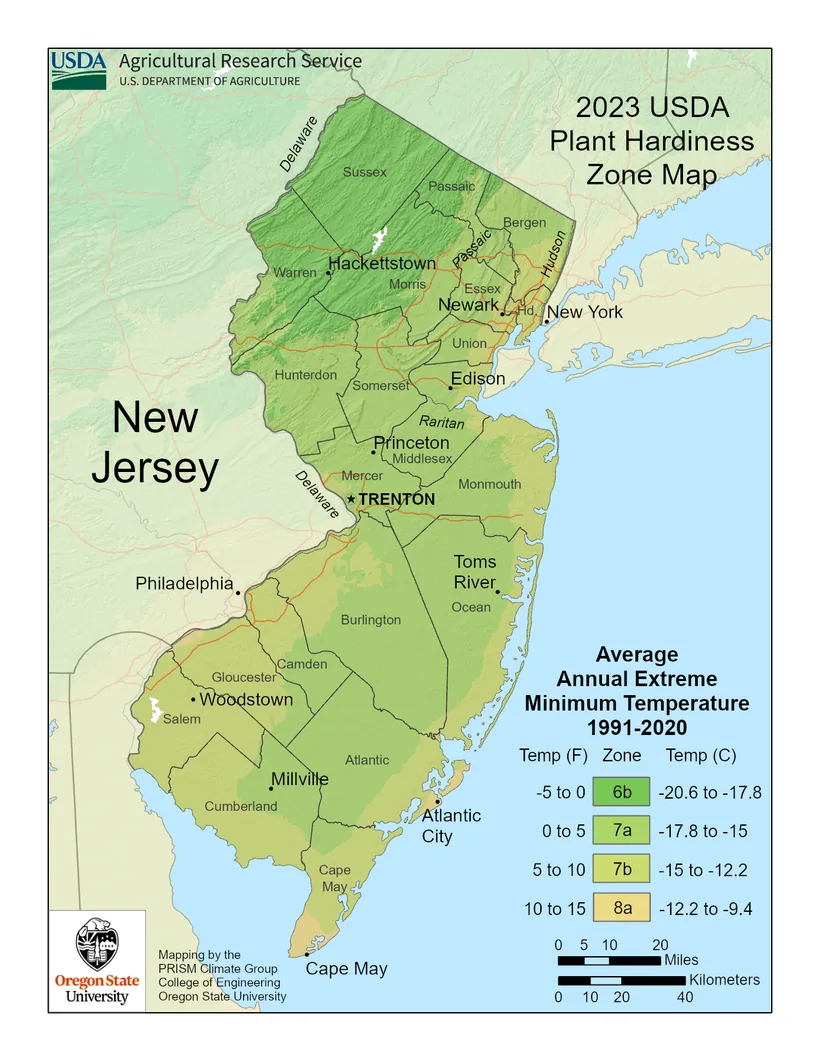
New Jersey spans USDA hardiness zones 6b through 8a on the 2023 map. Most of the state falls somewhere inside that range, and the zone for your own yard depends on elevation, urban heat and exposure.
The range above comes from published state-by-state summaries of the 2023 USDA map. For an exact zone, enter your ZIP code in the official USDA tool.
Lawn grasses for New Jersey
Lawn grass is chosen by climate region as well as hardiness zone. Based on extension turfgrass guidance, we place New Jersey in these regions: cool-humid (north); transition (central/south). This is our own approximate summary, not an official map, and conditions change with elevation and distance from the coast.
Commonly used grasses: turf-type tall fescue, Kentucky bluegrass (north/shade-free sites), zoysiagrass, bermudagrass.
Sources: gardenia.net; prettypurpledoor.com; planthardiness.ars.usda.gov. Data retrieved October 1, 2026.
What New Jersey’s zone range means in winter
USDA zones are defined by the average annual extreme minimum winter temperature. New Jersey’s range of 6b to 8a covers average coldest nights from about -5 °F to 15 °F, depending on where in the state you are. Plants and grasses must survive the low end of that range where you live.
| Zone | Average coldest night |
|---|---|
| 6b | -5 to 0 °F |
| 7a | 0 to 5 °F |
| 7b | 5 to 10 °F |
| 8a | 10 to 15 °F |
The grasses used in New Jersey, in more detail
- Bermudagrass: a tough warm-season grass for sun, heat, drought and heavy traffic, though it does poorly in shade.
- Zoysiagrass: a dense warm-season grass with good shade and wear tolerance that is slow to establish and usually planted as sod or plugs.
- Tall fescue: a cool-season grass that handles heat and drought better than its relatives and works across the transition zone.
- Kentucky bluegrass: a dense cool-season grass that repairs itself by spreading and is the usual choice for northern lawns with good sun.
Cool-season grasses on New Jersey’s list, such as Tall fescue, Kentucky bluegrass, grow best in mild weather, so they are usually seeded in late summer to early fall, with spring a second choice.
Warm-season grasses on the list, such as Bermudagrass, Zoysiagrass, grow fastest in summer heat, go dormant and tan after the first hard frost where frosts occur, and are planted in late spring to early summer once the soil is warm.
Frequently asked questions
What planting zone is New Jersey?
New Jersey ranges from zone 6b to zone 8a on the 2023 USDA Plant Hardiness Zone Map. Check your ZIP code on the USDA site for your exact zone.
What grass grows best in New Jersey?
It depends on where you live in the state. Grasses commonly used in New Jersey include turf-type tall fescue, Kentucky bluegrass, zoysiagrass, bermudagrass.
What is the best time to plant grass in New Jersey?
Cool-season grasses are usually seeded in late summer to early fall and warm-season grasses in late spring to early summer. Use your local extension office for dates specific to your county.
Explore the whole Calcs family here.
Not happy with our calculations or how it works? Let us know.
Have a suggestion for a calculator you don't see here? Let us know.
All LawnCalcs tools
Mulch, Soil & Stone
Mulch Calculator Topsoil Calculator Gravel Calculator Pea Gravel Calculator Sand Calculator River Rock Calculator Cubic Yard Calculator Raised Bed Soil Calculator Paver Calculator Paver Base & Sand Calculator Retaining Wall Block CalculatorLawn & Garden
Sod Calculator Grass Seed Calculator Lawn Fertilizer Calculator Plant Spacing CalculatorLawn & Landscape Costs
Tree Removal Cost Calculator Sod Installation Cost Calculator Landscaping Cost Calculator Paver Installation Cost Calculator Artificial Turf Cost Calculator Sprinkler System Cost Calculator Lawn Mowing Cost Calculator Lawn Mowing Bid CalculatorConverters
Square Feet to Acres Converter Acres to Square Feet Converter Square Feet to Cubic Yards Converter Cubic Feet to Cubic Yards Converter Tons to Cubic Yards Converter Bags to Cubic Yards Converter Square Meters to Square Feet Converter Hectares to Acres Converter Cubic Meters to Cubic Yards Converter Centimeters to Inches ConverterFinders & Quizzes
Grass Type Finder Tree Finder Material Finder What Is My Lawn Type? Which Tree Fits My Yard?Grass Guides
Grass Seed Rates Chart Kentucky Bluegrass Perennial Ryegrass Tall Fescue Grass Fine Fescue Grass Bermudagrass Zoysiagrass St. Augustinegrass Centipedegrass Bahiagrass BuffalograssTree Guides
American sycamore Quaking aspen Hybrid poplar Eastern cottonwood Weeping willow Red maple Silver maple Sugar maple Northern red oak White oak River birch Crape myrtle Eastern redbud Flowering dogwood Green Giant arborvitae Leyland cypress Norway spruce Eastern white pine Bradford or Callery pear Crabapple Southern magnolia Japanese maple Honeylocust Ginkgo Fast Growing TreesNo tools match your search.